
Strategic Permanent Medical Staffing Agency Guide for Healthcare Leaders in 2026
Background
Most hospitals and clinics have experienced the profound strain which persistent vacancies place upon their ability to maintain clinical service continuity and patient care. The additional workload placed upon existing staff often leads to systemic burnout and a reliance on fragmented internal solutions. Whilst most healthcare organisations aim to source adequate numbers of permanent staff, current conditions of specialist shortages make this an often insurmountable challenge.
The obvious solution is the locum tenens. Much maligned and criticized as the cause of service disruption, logistical friction and expanding costs, the locum tenens nevertheless plays a vital role in preserving acute clinical services at times of staff shortages.
This guide demonstrates how to leverage international locum tenens staffing to eliminate workforce gaps and ensure seamless clinical continuity across every department. By moving beyond reactive hiring, hospital managers can establish a reliable pipeline of pre-vetted specialist doctors whilst significantly reducing the administrative burden traditionally associated with complex credentialing processes. We will explore the methodologies for optimising a hospital’s operational efficiency and securing high-quality temporary hires which align perfectly with existing clinical culture.
Key Takeaways
- Reframe locum coverage as a sophisticated tool for long-term workforce stability rather than a reactive response to consultant fatigue.
- Identify the critical compliance benchmarks required by international bodies, such as the GMC and AHPRA, to ensure every placement meets rigorous clinical standards.
- Evaluate the comprehensive financial benefits of locum tenens staffing for hospitals by analysing the hidden costs of service disruption and outsourced patient care.
- Streamline the onboarding process through structured internal protocols that facilitate the immediate operational efficacy of incoming temporary specialists.
- Leverage a curated global network of pre-vetted specialists in high-demand fields like surgery and emergency medicine to maintain uninterrupted service delivery.
The Strategic Role of Locum Tenens Staffing for Hospitals
The contemporary application of the locum tenens model within global healthcare systems has transcended simple substitution. For modern medical directorates, locum tenens staffing for hospitals represents a sophisticated lever for operational stability rather than a panicked response to unforeseen absences. By integrating highly skilled temporary clinicians into the core workforce strategy, institutions can maintain clinical continuity, which is the foundational requirement for patient safety and institutional reputation. This approach ensures that the standard of care remains uncompromised, regardless of internal staffing fluctuations or sudden increases in patient volume.
Hospitals are increasingly adopting these flexible staffing solutions to address the pervasive issue of consultant burnout. When permanent teams are stretched across multiple vacancies, the resulting fatigue compromises care quality and accelerates further resignations. A proactive approach allows leadership to preserve the well-being of their staff whilst ensuring that departmental throughput remains consistent with national targets. This shift from reactive "emergency cover" to proactive workforce agility is essential for any facility aiming to remain competitive in a strained global market where specialist talent is in high demand.
Combatting the Global Healthcare Vacancy Crisis
The impact of unfilled permanent posts extends far beyond administrative inconvenience; it often results in the suspension of elective surgery lists and the potential closure of vital regional departments. By utilising locum tenens staffing for hospitals, regional centres can prevent the diversion of patients to distant facilities, thereby maintaining local access to specialist care. This ensures that elective throughput remains stable, protecting the hospital's revenue streams and preventing the accumulation of daunting surgical backlogs. Maintaining a full roster through flexible staffing also protects the existing team from the demoralising effects of chronic understaffing and heavy on-call burdens.
Beyond the "Stop-Gap": Locums as a Growth Catalyst
Strategic recruitment also facilitates the expansion of clinical services without the immediate commitment of a permanent hire. Hospitals can pilot new medical programmes or specialised clinics by bringing in temporary specialists who possess diverse clinical expertise from various international healthcare systems. This approach allows for the validation of new service lines whilst the organisation conducts a meticulous global search for a permanent consultant. It effectively bridges the gap between ambition and operational reality, allowing for growth that is not hindered by the lengthy timelines of traditional recruitment cycles.
Bringing in experts from different systems often introduces innovative clinical behaviours and efficiencies that benefit the entire department's performance.
Ensuring Clinical Excellence: The Credentialing and Compliance Framework
Maintaining clinical excellence in a high-pressure environment requires an uncompromising approach to medical credentialing. It is not enough to simply fill a rota; every placement within the framework of locum tenens staffing for hospitals must undergo rigorous scrutiny to align with the safety standards of the host institution. This process involves far more than verifying a medical degree. It necessitates a deep dive into professional history, clinical competency, and ethical standing across multiple jurisdictions. When hospitals fail to prioritise these non-negotiables, they risk compromising the very patient safety they're sworn to uphold.
The complexities of this verification are underscored by the broader Economics of Staffing: Locum Investment vs. Cost of Vacancy, where the financial and clinical risks of a compliance failure can be catastrophic.
We utilise a meticulous 10-point candidate vetting and verification process. This includes primary source verification of all qualifications, criminal record checks, and a thorough review of clinical references from the last two years of practice. It is a system designed to provide absolute certainty before a doctor ever steps onto a ward, ensuring that their skills are as robust as their documentation suggests.
Navigating International Medical Registration
Registration with bodies such as the General Medical Council (GMC) in the United Kingdom or the Australian Health Practitioner Regulation Agency (AHPRA) involves intricate timelines and specific documentation.
We manage the delicate balance of primary source verification whilst ensuring that visa sponsorship and work permits are processed in accordance with local immigration laws. Our team also verifies that every clinician maintains appropriate professional indemnity and insurance. These are non-negotiable requirements for safe practice in highly regulated environments, yet they are often overlooked by less specialised agencies. We ensure that every international candidate is fully compliant before they arrive at your facility.
Quality Assurance and Performance Monitoring
Effective locum tenens staffing for hospitals relies on establishing clear clinical KPIs and structured feedback loops between the hospital and the agency. Hospitals should conduct a formal local induction, familiarising temporary staff with specific electronic patient records and departmental protocols.
Regular performance reviews ensure that standards remain high throughout the assignment. We recommend formal handover protocols during temporary-to-permanent shifts to preserve the integrity of patient care plans. For those seeking a partner that understands these nuances, exploring Locum Tenens Assignments through a specialist agency can provide the necessary clinical oversight and peace of mind.
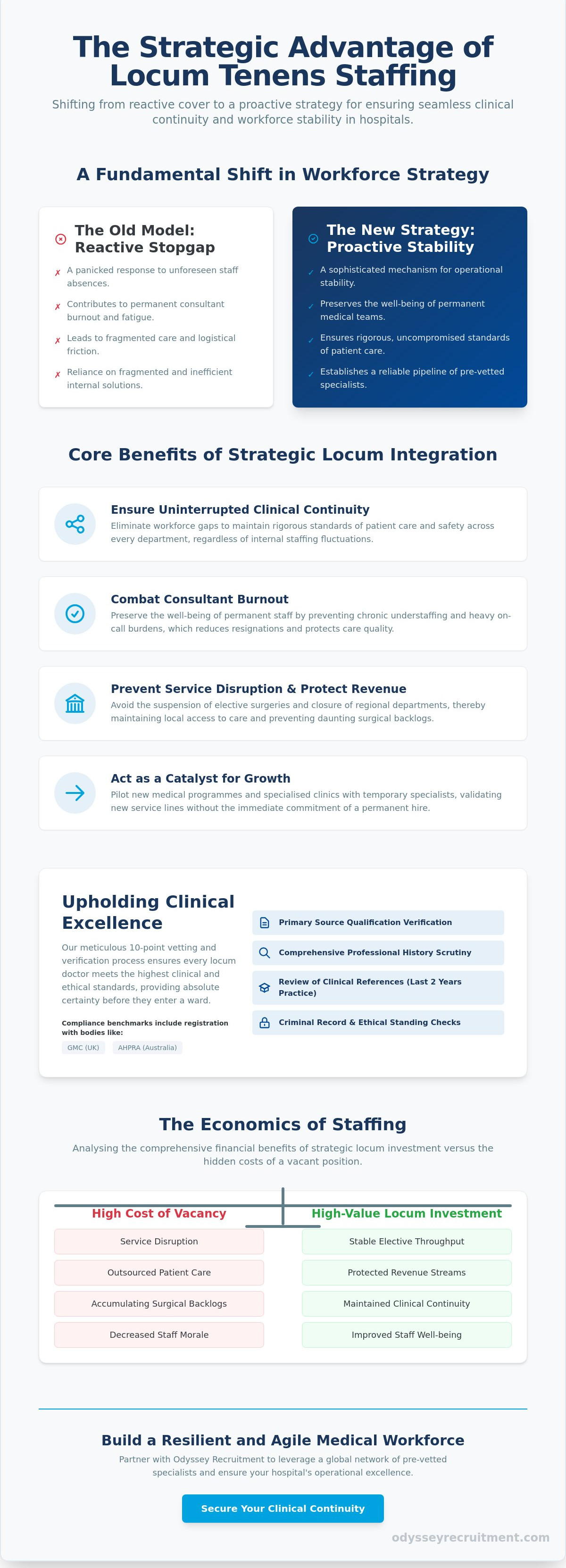
The Economics of Staffing: Locum Investment vs. Cost of Vacancy
The fiscal evaluation of clinical workforce management necessitates a perspective that extends beyond the immediate daily rate of a temporary clinician. Whilst administrators often categorise locum tenens staffing for hospitals as a premium expenditure, a more rigorous analysis reveals that the "Cost of Vacancy" frequently exceeds the investment required for professional cover. When a specialist post remains unfilled, the financial repercussions ripple through the organisation, manifesting as lost surgical revenue, cancelled outpatient clinics, and the expensive necessity of outsourcing care to private providers to meet government waiting-time targets. Strategic use of temporary staff ensures that these revenue-generating assets remain functional and productive.
Recent research on the locum tenens model underscores its transition from a temporary fix to a strategic financial instrument. By maintaining service continuity, hospitals protect their primary revenue streams and avoid the systemic degradation of their permanent workforce. A planned approach to locum integration allows for budgetary predictability, ensuring that short-term costs serve the long-term goal of operational stability. Transparency in fee structures remains essential; administrators should prioritise partners who provide comprehensive breakdowns of clinician remuneration and insurance to ensure they're achieving genuine value for their investment.
Protecting Hospital Revenue Streams
Idle operating theatres represent a significant drain on capital, as fixed overheads continue to accrue whilst surgical revenue ceases. Utilising locum tenens staffing for hospitals allows facilities to honour their contractual performance targets and maintain high patient satisfaction scores by avoiding the disruption of care pathways. This consistency is vital for protecting the hospital's reputation amongst the community and referring general practitioners. By keeping clinics open and lists running, the hospital ensures that its financial health remains as robust as its clinical outcomes.
The Hidden Costs of Unfilled Posts
The financial burden of an unfilled post extends to the permanent team, where increased burnout leads to higher turnover rates and subsequent recruitment costs. Replacing a permanent consultant involves significant expenditure on international searches, interviews, and onboarding, which can be mitigated by using locums to stabilise the environment whilst a search is conducted.
Hospitals must avoid the "Agency Spiral", where reactive, last-minute hiring leads to inflated costs and inconsistent quality. A strategic partnership with a specialist recruiter allows for a more controlled, cost-effective approach to managing vacancies without compromising the well-being of the existing staff.
This is paragraph text. Click it or hit the Manage Text button to change the font, color, size, format, and more. To set up site-wide paragraph and title styles, go to Site Theme.
Implementation Guide: Integrating Locums into Hospital Operations
Successful locum tenens staffing for hospitals requires a transition from reactive administration to proactive operational integration. It is insufficient to merely secure a clinician; the institution must prepare the environment to ensure immediate clinical efficacy. This begins with a robust internal protocol for requesting and approving staff, which bridges the gap between departmental needs and budgetary oversight. By synchronising HR, Finance, and Clinical Leads, hospitals can eliminate the delays that often lead to service disruption.
Creating a digital orientation pack is a critical component of this preparation. This resource should be distributed well before the clinician arrives, providing essential information on local clinical guidelines and referral pathways. Assigning a clinical mentor or peer contact for every visiting doctor provides a steady hand during the initial transition, allowing them to focus on patient care rather than administrative hurdles. This methodical approach to locum tenens staffing for hospitals transforms a temporary assignment into a seamless extension of the permanent team.
The 72-Hour Orientation Framework
A structured 72-hour framework ensures that incoming specialists gain immediate access to critical systems, including Electronic Medical Records (EMR), pathology results, and prescribing protocols. Without these digital keys, even the most experienced consultant remains operationally limited. The orientation must also introduce the practitioner to the unique multi-disciplinary team dynamics and the specific departmental culture, fostering a sense of professional belonging that enhances performance. This ensures that clinical safety is maintained from the first hour of the first shift.
Strategic Workforce Planning for 2026
In 2026, hospitals must leverage predictive analytics to anticipate seasonal staffing surges and identify "hard-to-fill" specialities that require a long-term strategy. Mapping out planned leave and retirement dates across the consultant body allows leadership to secure high-quality cover well in advance.
Reviewing the efficacy of these placements through quarterly data audits ensures that the hospital’s workforce remains both agile and cost-effective. For organisations seeking to refine these processes, exploring Permanent Medical Recruitment and locum strategies with a dedicated partner can provide the necessary foresight.
Partnering for Global Talent: The Odyssey Recruitment Advantage
Odyssey Recruitment serves as a sophisticated navigator for healthcare institutions seeking to transcend local talent shortages through a curated global network of medical professionals. We provide exclusive access to a talent pool of specialists trained in the United Kingdom, Europe, North American and Australia, ensuring that the clinical standards of your facility are maintained by practitioners who are accustomed to rigorous healthcare environments.
Our expertise in locum tenens staffing for hospitals focuses on high-demand specialities such as Emergency Medicine, Anaesthesia, Internal Medicine, Psychiatry, and Surgery, where vacancies often present the most significant risk to clinical continuity and departmental safety. By focusing on these critical areas, we help organisations maintain their elective throughput and emergency response capabilities without compromise.
Managing the administrative and regulatory burden of international recruitment requires a level of meticulous attention that many internal HR teams find difficult to sustain alongside their daily operations. We assume full responsibility for the end-to-end management of these complex processes, from the initial 10-point vetting procedure to the final verification of clinical credentials and indemnity.
This boutique, high-touch approach allows hospital leadership to focus on their overarching strategic objectives whilst we ensure that every temporary clinician is fully prepared to integrate into the ward or theatre. We're committed to building long-term partnerships that foster sustainable healthcare workforce models, moving away from the fragmentation of traditional agency interactions.
A Global Network with Local Expertise
Our presence across the Middle East, Australia, North America, Asia and Europe provides an unparalleled advantage for hospitals operating in diverse jurisdictions. We understand the specific clinical nuances and cultural expectations of different healthcare systems, which allows us to match practitioners who aren't just technically proficient but also professionally compatible with your local environment.
In one instance, we successfully resolved a critical consultant shortage in a regional hospital by deploying a team of three Australian-trained Emergency Medicine specialists within a six-week window, preventing the diversion of acute cases to a metropolitan centre. This level of responsiveness is essential for maintaining the reputation and operational integrity of regional healthcare providers.
Next Steps for Hospital Leadership
To move beyond reactive hiring, hospital leadership should engage in a comprehensive workforce consultation to identify current and future gaps within their directorates. Our team provides detailed insights into fee structures and bespoke service level agreements that prioritise long-term operational stability over quick, transactional placements.
We offer tailored staffing solutions for both large-scale public hospitals and specialised private clinics, ensuring that your specific patient demographic receives the highest standard of care. You can enquire about our locum tenens staffing solutions for hospitals to begin developing a sustainable workforce model that protects both your patients and your permanent staff.
Frequently Asked Questions
What is the typical lead time for securing a locum tenens doctor for a hospital?
Lead times for securing a locum clinician vary significantly based on the doctor's current location and the specific medical registration requirements of the host country. For domestic placements, cover can often be arranged within a few days or weeks; however, international assignments typically require a lead time of three to six months to account for medical board processing and visa formalities. We recommend early engagement to ensure that all compliance benchmarks are met before the desired start date.
Can a locum tenens assignment be converted into a permanent hospital position?
Converting a locum tenens assignment into a permanent hospital position is a frequent and often preferred outcome for both the clinician and the healthcare facility. This "clinical trial" period allows the hospital to evaluate the doctor's performance and cultural integration before committing to a long-term contract. Such transitions are managed through specific clauses within our service level agreements, ensuring a transparent and seamless shift from temporary to permanent status.
What are the typical travel and housing arrangements for international locum doctors?
Travel and housing arrangements for international locum doctors are typically subsidised or provided directly by the host hospital as part of the total compensation package. This usually includes return airfares and suitable self-contained accommodation located near the clinical site. We coordinate these logistics meticulously to ensure the clinician arrives well-rested and prepared to commence their duties without the distraction of unsettled living arrangements.
What happens if a locum doctor is not a good clinical or cultural fit for the hospital?
If a locum doctor is not a suitable clinical or cultural fit, we facilitate a professional resolution in accordance with the terms of our service level agreement. This process prioritises clinical safety and departmental harmony, often involving the swift identification of a replacement clinician to maintain service continuity. We maintain active feedback loops throughout the assignment to identify and address any potential friction points before they escalate into significant operational issues.
Do locum tenens doctors have the same prescribing rights as permanent staff?
Locum tenens doctors possess the same prescribing rights as permanent staff, provided they hold full registration with the relevant national medical board and have completed the hospital's local induction. Access to electronic prescribing systems and pathology results is a critical component of the 72-hour orientation framework. Once these administrative hurdles are cleared, temporary clinicians operate with full clinical autonomy within their scope of practice.
How does Odyssey manage the visa and medical registration process for overseas staff?
Odyssey Recruitment provides end-to-end management of the visa and medical registration process, acting as a steady hand through complex international systems. We navigate the specific requirements of bodies such as the GMC or AHPRA, ensuring that all documentation is accurate and submitted within the necessary timeframes. This comprehensive service significantly reduces the administrative burden on internal HR teams, allowing hospital leadership to focus on clinical delivery whilst we manage the regulatory hurdles of locum tenens staffing for hospitals.
29 May 2026
Share this post on Social Media
More Insights