
Consultant Physician Jobs in the Middle East: Market Trends and Opportunities
This is a subtitle for your new post
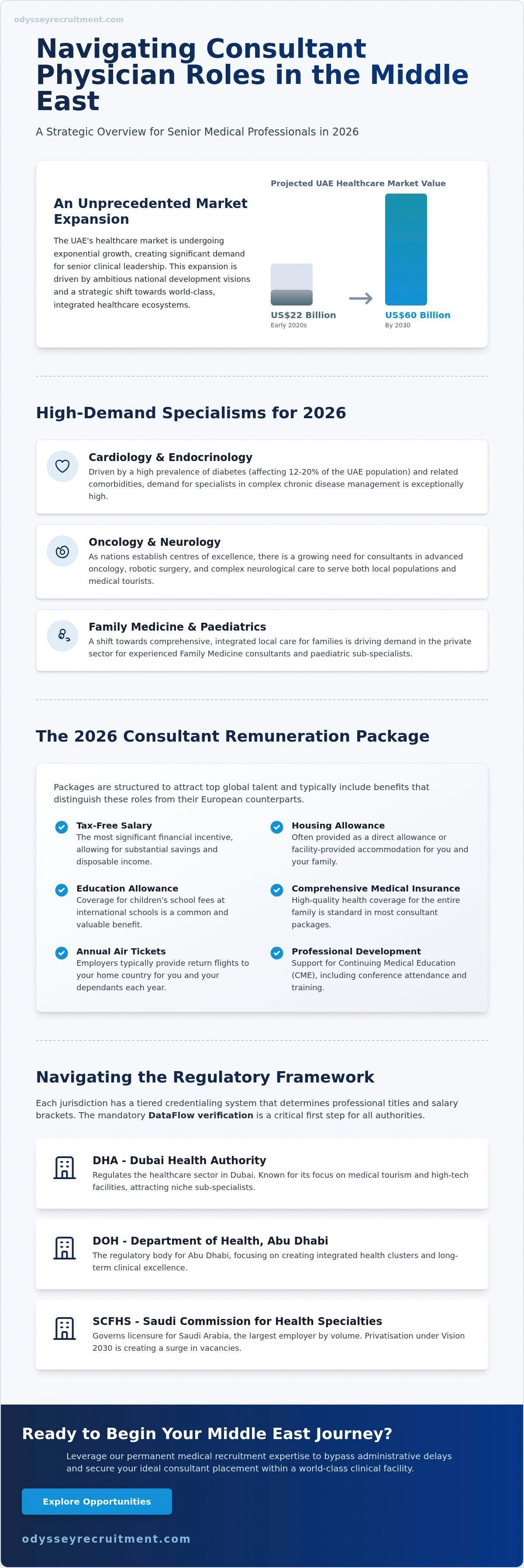
By 2030, the healthcare market in the United Arab Emirates is projected to expand to US$60 billion, which represents a substantial increase from its US$22 billion valuation earlier this decade. Such rapid growth creates exceptional demand for senior clinical leadership, yet the process of securing consultant physician jobs in this region often feels obscured by intricate licensing protocols and valid concerns regarding clinical infrastructure. It is advisable to seek absolute certainty before committing to a career move which involves family relocation and long-term contract stability within a foreign jurisdiction.
This article provides the strategic clarity you need to navigate the 2026 recruitment landscape, ensuring you are prepared for the rigorous standards of the modern Gulf healthcare sector. We will examine the transition towards integrated care networks, provide a clear roadmap for mandatory DataFlow verification, and confirm the substantial financial rewards available to senior specialists.
By the end, you will possess a comprehensive understanding of how to align your professional goals with the region's ambitious national development visions whilst maintaining the highest clinical standards.
Key Takeaways
- Examine how national development strategies, such as Saudi Vision 2030, are driving a fundamental shift towards integrated care networks and outpatient services.
- Identify the clinical specialisms facing the most significant vacancy gaps, providing insight into why chronic disease management remains a priority for those seeking consultant physician jobs in the Middle East.
- Understand the comprehensive components of a standard 2026 remuneration package, including tax-free salary structures and the professional benefits that distinguish these roles from European counterparts.
- Gain a clear overview of the regulatory landscape, including the tiered credentialing systems used by the DHA, DOH, and SCFHS to determine professional titles and salary brackets.
- Discover how leveraging permanent medical recruitment expertise allows senior professionals to bypass administrative delays and secure placements within world-class clinical facilities.
The Evolution of Healthcare in the Middle East: 2026 Market Overview
Within the sophisticated framework of the Gulf's medical sector, the role of a Consultant Physician has transitioned from a purely clinical designation to a pivotal leadership position. In 2026, senior clinicians are expected to spearhead departmental strategy, mentor junior staff, and ensure rigorous adherence to international standards across both state-funded and private facilities.
This evolution reflects a broader regional commitment to establishing consultant physician jobs in the Middle East as some of the most prestigious roles in global medicine. Unlike the fragmented hospital models of the previous decade, the current landscape prioritises integrated health clusters which streamline patient pathways and consolidate specialist expertise. These clusters are designed to foster collaboration, ensuring that a consultant's influence extends far beyond their immediate ward or clinic. .
The Influence of National Health Visions
The ongoing transformation of the Healthcare System in Saudi Arabia serves as a primary catalyst for market growth, particularly as the privatisation of public hospitals under Vision 2030 creates a surge in high-level vacancies. Governments are no longer simply building facilities; they're creating entire ecosystems that require seasoned directors and clinical leads.
Securing consultant physician jobs in the Middle East within these networks often involves working in environments that are undergoing rapid digitisation and structural reform. Whilst Saudi Arabia remains the largest employer by volume, Dubai and Abu Dhabi have refined their strategies to focus on medical tourism, driving demand for niche sub-specialists in fields like robotic surgery and advanced oncology.
Simultaneously, Qatar and Oman have emerged as competitive alternatives, offering senior physicians stable, long-term environments that rival the traditional hubs in terms of clinical infrastructure and lifestyle benefits.
Shifting from Quantity to Clinical Quality
Regional health ministries have deliberately moved away from the "locum-heavy" staffing models that characterised the early 2010s. Today, there's a distinct preference for permanent recruitment, as facilities seek to build sustainable clinical governance frameworks and achieve Joint Commission International (JCI) accreditation.
This shift places a premium on Western-trained specialists, specifically those holding CCT or American Board certification, who can provide the institutional leadership required for these modern health ecosystems. Hospital boards now prioritise candidates who demonstrate a commitment to long-term departmental growth and patient safety initiatives.
The 2026 market is best defined as a quality-driven specialist hub which prioritises long-term clinical excellence and commitment over temporary staffing solutions. This focus on durability ensures that consultants aren't just visiting practitioners but are integral to the region's long-term medical legacy.
High-Demand Specialisms for Consultant Physician Jobs
Regional healthcare priorities in 2026 are increasingly defined by the epidemiological profile of the local population. Whilst generalist roles remain essential, the most significant vacancy gaps for consultant physician jobs in the Middle East are found in highly specialised tertiary care fields.
Currently, the most sought-after specialisms include Cardiology, Oncology, Neurology, Gastroenterology, and General Surgery. These areas reflect the region's strategic focus on addressing the rising prevalence of non-communicable diseases. Chronic disease management remains a central pillar for regional health ministries. With an estimated 12% to 20% of the population in the UAE affected by diabetes, there's a persistent need for Endocrinologists and Cardiologists who can manage complex, long-term comorbidities. The requirements are precise.
The private sector is witnessing a surge in demand for mental health professionals and paediatric sub-specialists as families increasingly seek comprehensive, integrated care locally rather than travelling abroad. This shift is particularly evident in Dubai and Riyadh, where private health groups are competing to offer world-class specialist clinics.
For female Consultant Physicians, Obstetrics and Gynaecology continues to offer unparalleled career stability and growth. This demand is driven by both cultural preferences and the rapid expansion of dedicated women's health centres across the Gulf. If you're considering a move, you might explore permanent medical recruitment options to identify which facilities align with your specific expertise.
The Rise of Tertiary Care and Sub-specialisation
As regional centres of excellence expand, the focus has shifted towards Oncology and Transplant surgery. These facilities require "Super-specialists" who are capable of establishing new clinical protocols. These practitioners are instrumental in training junior staff and ensuring that regional facilities meet the rigorous standards set by bodies such as the Saudi Commission for Health Specialties.
This level of sub-specialisation is no longer a niche requirement; it's a fundamental component of the region's strategy to reduce outbound medical tourism. Hospitals now prioritise those who can build departments from the ground up.
Clinical Leadership and Departmental Management
The 2026 recruitment cycle places a distinct value on "Physician-Leader" profiles. Modern Middle Eastern hospitals, particularly those within the newly formed health clusters, seek Consultants who possess formal administrative or leadership experience.
Consultants will be expected to lead research initiatives, manage departmental budgets, and oversee academic programmes which foster local talent. Clinical excellence must be paired with the ability to navigate complex corporate and regulatory environments. Hospitals value professionals who can balance high-volume patient care with strategic departmental oversight.
The 2026 Consultant Package: Remuneration and Lifestyle
The financial structure of consultant physician jobs Middle East remains one of the most compelling reasons for senior medical relocation. In 2026, a standard package is far more than a simple monthly salary; it's a multi-faceted compensation agreement designed to support a high standard of living for the practitioner and their family.
In Dubai, for instance, the average gross salary for a Consultant Physician is 1,001,204 AED per year, whilst senior-level consultants with over eight years of experience often earn an average of 1,159,427 AED. When compared to gross earnings in the UK or Europe, the tax-free status of these salaries provides a significantly higher net disposable income. High-demand sub-specialists in interventional cardiology or robotic surgery can command monthly packages exceeding 120,000 AED. These packages are often supplemented by profit-sharing arrangements. Market dynamics remain stable.
Contracts also include annual air tickets for the employee and their dependents, alongside a continuing medical education (CME) allowance of up to 20,000 AED. One of the most significant long-term benefits is the end-of-service gratuity, often referred to as indemnity. This payment, calculated based on the length of service and final basic salary, provides a robust financial cushion upon the conclusion of a contract. The requirements are precise.
Analysing the Financial Advantage
Whilst the cost of living in cities like Riyadh, Dubai, and Doha has risen substantially, the absence of income tax ensures that net earnings remain superior to most Western counterparts. Private healthcare providers frequently include performance-based incentives, typically ranging between 10% and 20% of the annual salary.
It is confirmed that 2026 contracts continue to prioritise comprehensive family health insurance, providing peace of mind regarding the quality of care available to the consultant's own household. This stability is a key differentiator.
Lifestyle and Cultural Integration for Expats
Relocating to the Gulf involves a cultural adjustment, yet the cosmopolitan nature of major hubs makes this transition manageable for most families. The region offers an exceptionally high standard of international schooling, with curricula spanning British, American, and International Baccalaureate systems.
Families are often drawn to the region's safety and security, which consistently ranks amongst the highest globally. These factors, combined with world-class leisure facilities, create an environment where professional success is matched by personal well-being.
Navigating the Regulatory Framework: Licensing and Credentialing
The administrative journey toward securing consultant physician jobs in the Middle East is governed by a rigorous regulatory framework designed to ensure clinical safety and professional integrity. The primary authorities managing these standards are the Dubai Health Authority (DHA), the Department of Health - Abu Dhabi (DOH), and the Saudi Commission for Health Specialties (SCFHS).
Each body operates under a "Tiered" system of medical qualifications, which is a critical factor in determining your professional title, scope of practice, and subsequent salary bracket. Practitioners must understand that their credentials aren't merely checked; they're verified through the DataFlow Primary Source Verification (PSV) process. This mandatory procedure involves direct contact with the awarding institutions to confirm the authenticity of degrees and employment history. Costs for this vary, with the SCFHS verification typically ranging between 400 and 900 SAR, whilst the DOH in Abu Dhabi requires 1,680 AED for consultants.
The timeline for licensing and visa issuance in 2026 generally spans three to six months, depending on the efficiency of document retrieval. This period accounts for the initial application, PSV completion, and the subsequent issuance of a Certificate of Good Standing, which must be no older than six months at the time of submission. For those targeting Qatar, it's essential to note that as of January 2026, DataFlow PSV is mandatory for all applicants under the Department of Healthcare Professions (DHP), with no exceptions permitted.
Navigating these requirements requires precision and early preparation. If you're ready to begin this process, you can explore our permanent medical recruitment services to receive expert guidance on specific regional mandates.
Understanding the Tier 1 Qualification Advantage
Regulators categorise international medical qualifications into tiers, with Tier 1 representing the highest level of recognition. This category includes the UK's Certificate of Completion of Training (CCT), the Irish CSCST, the American Board certification, the FRCSC from Canada and the equivalent Australian specialist fellowships.
Holding a Tier 1 credential provides a significant advantage, often exempting the physician from the Prometric licensing exam and simplifying the overall registration process. This status doesn't only accelerate the timeline but also positions the candidate for the most lucrative senior roles and leadership positions. It's vital that you verify your specific tier status before beginning a job search to ensure your expectations align with regional standards.
The Practical Steps of Credentialing
The initial application phase requires a meticulous compilation of documentation to avoid common administrative delays. You will need to provide notarised copies of your medical degrees, specialist certificates, and a valid licence from your current jurisdiction. For those in surgical or interventional specialisms, maintaining a detailed "Logbook" of procedures performed over the last two years is indispensable.
Before submitting, ensure you have:
- A Certificate of Good Standing (CGS) from your current medical board.
- Documented proof of all clinical experience post-specialisation.
- A clear, updated curriculum vitae that matches your verified DataFlow records.
Adhering to this checklist ensures a smoother transition through the regulatory gatekeepers.
Strategic Career Planning: Why Partner with Odyssey Recruitment?
Navigating the complexities of the Gulf healthcare market requires more than a standard job search; it demands a strategic partnership with a specialist who understands the nuances of senior medical leadership positions and employer requirements.
Odyssey Recruitment operates as a boutique navigator for high-level professionals, leveraging over 20 years of experience to ensure your application reaches the correct decision-makers. By bypassing the "black hole" of generic portals, we facilitate direct engagement with clinical leads and hospital boards.
This approach is essential when pursuing consultant physician jobs in the Middle East, as the most prestigious positions are often filled through trusted networks rather than public advertisements. We provide comprehensive support, beginning with meticulous CV tailoring that highlights your Tier 1 credentials and extending to post-arrival relocation advice. Our expertise ensures that your professional transition is handled with the same precision you apply to your clinical practice.
Personalised Sourcing and Negotiation
Our consultants maintain direct relationships with Chief Medical Officers and board members, allowing us to identify "unlisted" roles that haven't yet reached the open market. This network is particularly valuable for sub-specialists who require specific clinical environments or research facilities. When a suitable match is identified, we negotiate contract terms on your behalf, ensuring that the remuneration, allowances, and professional incentives reflect your expertise and the current market value. We invite you to register your interest for a confidential consultation regarding your career trajectory. This personalised approach ensures that your specific requirements are met before you commit to a contract.
Long-term Success and Relocation Support
Ethical recruitment and regulatory compliance form the foundation of our service. We recognise that relocating a family is a significant undertaking, which is why we manage the heavy logistical burden associated with international transitions. Our team ensures that your credentialing aligns perfectly with regional mandates whilst providing practical advice on housing, schooling, and local integration.
By prioritising long-term partnerships over transactional placements, we ensure that your transition into the Middle Eastern healthcare sector is both professional and sustainable. Please explore our latest Consultant Physician vacancies in the Middle East to begin your journey with a trusted advisor by your side.
Frequently Asked Questions
What are the main requirements for a Consultant Physician job in the Middle East?
The primary requirements for a senior medical role include holding a recognised specialist qualification, such as a CCT or American Board certification, and possessing a minimum of two to five years of post-certification experience. You must also provide a valid Certificate of Good Standing from your current regulatory body and successfully complete the Primary Source Verification process for all educational and professional credentials. These standards ensure that practitioners in consultant physician jobs Middle East meet the rigorous clinical expectations of the region's modern healthcare systems.
How long does the licensing process take for doctors moving to the UAE or Saudi Arabia?
The licensing and credentialing process typically spans between three and six months from the initial application to the final issuance of a professional licence. This timeline accounts for the completion of mandatory DataFlow verification, the submission of clinical portfolios to authorities like the DHA or SCFHS, and the subsequent processing of your work visa. Early preparation of documents, particularly specialist certificates and references, is essential to avoid administrative delays during this transition.
Do I need to speak Arabic to work as a Consultant Physician in the Middle East?
Proficiency in the Arabic language is not a mandatory requirement, as English serves as the primary language for clinical documentation and professional communication within the majority of hospitals. Most facilities employ a diverse, international workforce and provide dedicated translation services to support patient interactions when necessary. Whilst learning basic Arabic phrases can be beneficial for building rapport, it's not a prerequisite for securing a senior clinical position.
Can my family join me if I take a medical job in the Middle East?
Family sponsorship is a standard component of senior medical contracts, allowing your spouse and children to relocate with you under a dependent visa. Most Consultant packages in 2026 include comprehensive family health insurance and substantial education allowances to ensure your dependents have access to the region's high-quality international schooling systems. The safety and stability of the Gulf hubs make them an attractive destination for families seeking a high standard of living.
Are there locum opportunities for Consultant Physicians in the Middle East in 2026?
Locum Tenens assignments remain a viable option for physicians, though the market has shifted its primary focus toward permanent, leadership-oriented placements. These short-term roles provide an excellent opportunity for specialists to experience the clinical environment and lifestyle of the Gulf before committing to a long-term contract. Many facilities utilise locum staff to manage seasonal demand or to bridge gaps whilst they finalise permanent recruitment for senior departmental positions.
14 October 2026
Share this post on Social Media
More Insights